Glossary of Terms
1080/24P
Refers to an internationally standardized High Definition production format (ITU BT 709) having a digital sampling
structure of 1920 (H) x 1080 (V) and operating at 24-frames per second progressively scanned. Often used to loosely
describe a system that operates at 23.976P as well.
1080/60i
Refers to a standardized High Definition production format (SMPTE 274M and ITU 709) having a digital sampling
structure of 1920 (H) x 1080 (V) and operating in interlaced scan mode at 60 fields per second. Often used to loosely
describe a system that operates at 59.94i as well.
1280x720
Refers to a high definition digital sampling structure of 1280 horizontally and 720 vertically. All 1280x720 images are
progressively scanned (720P).
16x9
The standardized aspect ratio of HDTV and Widescreen SDTV - having a width of 16 units and a height of 9 units.
1920x1080
Refers to a digital sampling structure of 1920 horizontally and 1080 vertically. 1920x1080 images can be scanned either
interlaced (1080i) or progressively (1080P).
Aspect Ratio (Picture)
The ratio of screen width to screen height. Can be expressed as Width by Height (Example: 16x9, 4x3) or as calculated
ratio (1.33:1, 1.78:1)
Some common aspect ratios:
1.33 (4x3) Standard Television or Academy Standard
1.78 (16x9) HDTV
1.85 Academy Flat
2.35 Cinemascope
24P
Terminology for 24 full frames per second digital video progressively captured. In most cases it refers to the HD picture
format of 1920x1080, though it is also used with 1280x720 images as well. Often used to loosely describe a capture
system that operates at 23.976P as well.
24PsF
Term used to describe a 24 (or in common usage 23.98) frame progressive video that divides the video in segments of
even and odd lines for transmission and storage (and often display). Though transmitted similarly as an interlaced
signal, if treated as a progressive signal, does not cause the same harmful artifacts that interlace scanning causes.
29.97P
Terminology for 29.97 full frames per second digital video progressively captured.
30P
Terminology for 30 full frames per second digital video progressively captured. Often used to loosely describe a capture
system that operates at 29.97P.
3:2 Pulldown
The process used to convert 24 frame per second film or 24P video into 59.94i video. Technically the 3:2 pulldown
process consists of two parts, the "Pulldown", and the creation of the "3:2" cadence. The pulldown process is the
slowing down of the film or video to 23.976 frames per second. The 3:2 cadence is created by taking one frame of the
24 frame source and filling 3 of the 59.94 fields. The next frame of the 24 frame source will only fill 2 of the 59.94 fields,
the next frame 3 fields, the next frame 2 fields, etc. This sequence causes 4 of the 24 frame per second acquired
material to fit into 5 frames of the destination 59.94i video. The term is loosely used to describe the process of
converting 23.98P HD video to 59.94i even though there is only a 3:2 cadence added and not a pulldown performed.
59.94i
Describes an interlaced video signal where 1/2 of the total lines of the picture are captured and displayed every 1/59.
94th of a second.
59.94P
Describes a progressive video signal where all lines of the picture are captured and displayed every 1/59.94th of a
second.
60i
Describes a interlaced video signal where 1/2 of the total lines of the picture are captured and displayed every 1/60th
of a second. Often used to loosely describe a capture system that operates at 59.94i.
60P
Describes a progressive video signal where all of the total lines of the picture are captured and displayed every 1/60th
of a second. Often used to loosely describe a capture system that operates at 59.94P.
720/60P
Refers to a High Definition production format (SMPTE 296M) having a digital sampling structure of 1280 (H) x 720 (V)
and operating at 60-frames per second progressively scanned. Often used to loosely describe a capture system that
operates at 59.94P as well.
Capture Rate Resolution
How much information defines an image. There are two types of resolution, spatial and temporal. Spatial defines how
many pixels are used to make up a single image. Common spatial resolutions for HD are 1920x1080 and 1280x720.
Temporal defines how many images per second are displayed. Common temporal resolutions for HD are 24, 25, 30, 50,
and 60 frames per second.
CineAlta
Name for a line of products by Sony that are developed to produce film-like images. CineAlta menu settings are included
in several of Sony's high definition cameras.
Composite Video
A video signal where luminance and chrominance signals have been combined together. This process results in
restricted detail especially with color components. Most commonly used to describe NTSC or PAL video where the
luminance, chrominance, and horizontal and vertical synchronizing information have been combined into one analog
signal.
Component Video
A video signal where luminance and chrominance signals are kept as separate components. This allows signals to
retain detail components and eliminates encoding/decoding artifacts commonly found in composite video.
DV (DVCam, DVC Pro)
Refers to a standard definition video tape format that records a 4:1:1 signal with a 5:1 compression ratio for a total
bitrate of 25Mb/s. DV cassettes come in 2 sizes Standard and Mini. Audio can be either 48khz 16 bit stereo or 32kHz 12
bit 4 channel. DV is considered primarily a consumer-based format while DVCam and DVC Pro is used in both
professional and broadcast production applications.
DVCProHD / DVCProHD-EX
A High Definition videotape format developed by Panasonic. It uses 1/4" wide tape stock and records 22:11:11 8 bit HD
Video. It uses an extension of the DV compression and recording system to reduce the data rate to 100Mb/s. The tape
format supports 1920x1080 at 59.94i, and 60i and 1280x720 at 59.94P and 60P. The Panasonic Varicam format uses
the 1280x720 DVCProHD format to carry variable frame rate information. DVCProHD-EX is an extension of the
DVCProHD format and is able to record and playback up to 126 minutes of HD video on a single cassette.
DVD
Digital Versatile Disk, disk of the size of a CD, but with a storage capacity of up to 17 Gbyte. The single layer one side
DVD stores up to 4.7 Gbyte, more then eight time as much as on a CD. It is an ideal media for video and multi channel
audio applications. The term DVD has become synonymous with DVD-Video, which holds MPEG-2 compressed video,
multichannel audio, subtitles, menus, and other features onto a DVD disk for playback in industry standard players.
HDCam Format
A High Definition videotape format developed by Sony. It uses 1/2" wide tape stock and records 22:11:11 8 bit HD
Video. It uses per-filtering and compression that together reduce the data rate approximately 7:1 to 140Mb/s. The tape
format supports 1920x1080 at 23.98P,24P,25P,29.97P, 30P, 50i, 59.94i, and 60i.
HDCam SR Format
A next generation High Definition videotape format developed by Sony. It uses a 1/2" wide tape stock and can record
either 22:22:22 10bit HD video, 22:11:11 10bit HD Video, or a special double speed mode for 2 channels of 22:11:11
10 bit HD Video. It uses a light compression scheme to reduce the data rate 2.7:1 (for 22:11:11) to approximately
440Mb/s.
HDV
A format which uses DV cassette tapes for recording and playback of high-definition video. The HDV format includes
720p (progressive) and 1080i (interlace) specifications. The HDV format specifies the data recording of MPEG-2 inter-
frame compressed high-definition signals at either 19Mb/s or 25Mb/s.
High Definition
Usually refers to a video format consisting of either 720 active lines of progressive video or 1080 active lines of either
progressive or interlaced video.
Interlaced imaging
Imaging technique where all the odd lines of a picture are captured in one moment and the even lines are captured in
the next moment. When you put two of these "fields" together, you get a "frame" (all of the lines). Notice however that
a frame represents two moments in time. If there was movement between the capturing of these two fields, there will
be a blurry look if the image is stopped on a frame. This is not a problem when the program is played back at normal
speeds because the eye will merge the images into smooth motion. See Progressive Imaging.
NTSC
National Television Systems Committee. Also the name for the 525 line, 30 frame per second color TV standard mainly
used in North, Middle and South America and Japan.
PAL
Phase Alternation Line. This is the 625 line, 25frame per second color television system in use today in the United
Kingdom and much of Europe.
Progressive Imaging
All lines (whole frame) are captured at the same instant similar to shooting motion picture film. Each frame represents a
single moment in time. See interlaced imaging.
SECAM
Systeme Electronique Couleur Avec Memoire. This is the 625 line, 25frame per second color television system in use
today in France and the Middle East.
Standard Definition (SD)
Usually refers to an NTSC (or PAL) compatible video format consisting of 480 (576 for PAL) active lines of interlaced
video.
Varicam Format
A Panasonic camcorder system that provides electronic over and under-crank recording of high definition video. The
system records 720-progressive video at 60-frames per second. Using a system of frame markers in the Timecode User
Bits, Varicam can provide variable frame rate recording so that in-camera motion control is possible in an electronic
camcorder. Film camera systems have been able to accomplish over/under crank recording for many years, and is a
staple of film cinematography.
XDCam HD Format
A Sony HD recording format that provides the capability to record in both DVCam format with NTSC/PAL and 16:9/4:3
switchable modes, as well as the MPEG HD format onto a proprietary HD disc. The XDCam HD products record video
signals in 1080/59.94i, 50i, 29.97P, 25P, and native 23.98P using the “MPEG HD” codec that adopts the industry
standard MPEG-2 MP@HL compression. Users can select desired bit rates either from 35, 25, or 18 Mb/s depending on
their requirements for picture quality and recording length. The XDCam HD products use a nonlinear optical disc
developed specifically for professional recording applications. Sony XDCam HD Cameras provides over and under-crank
recording similar to film cameras as well as CineAlta settings.
Y, R-Y, B-Y
Terminology to describe the luminance (Y) and color difference signals (R-Y) and (B-Y) of component video such as
Betacam SP. Y is luminance information and the R-Y and B-Y signals together provide the color information. These
signals, derived from the original RGB source, are used in most video systems as a bandwidth reduction technique. Also
see component video.
|
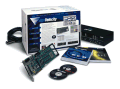 dpsVelocityT is the ultimate real time non-linear editing system for digital video and content creation professionals. A joint effort of DPS' award-winning hardware and software development teams, dpsVelocity delivers faster, sharper and easier edits while raising the bar for reliability and affordability. Whether creating content for broadcast, videotape, CD-ROM, DVD or the web, dpsVelocity is your best choice. dpsVelocityT is the ultimate real time non-linear editing system for digital video and content creation professionals. A joint effort of DPS' award-winning hardware and software development teams, dpsVelocity delivers faster, sharper and easier edits while raising the bar for reliability and affordability. Whether creating content for broadcast, videotape, CD-ROM, DVD or the web, dpsVelocity is your best choice.
At the heart of every dpsVelocity editing system is the dpsRealityT studio digital disk recorder card. This advanced hardware, which supports compressed and uncompressed video recording modes, delivers quality so sharp it surpasses Digital Betacam. Amazingly compact, the dpsReality card combines the functions of a dual stream DDR, video mixer/keyer, real time 3D effects processor, multi-channel audio mixer, SCSI controller and two graphics framestores in a single PCI slot.
|
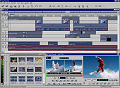
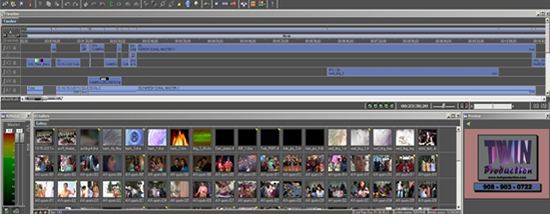
It takes an equally powerful software application to exploit the capabilities of the dpsReality hardware. The extensive real time capabilities of dpsVelocity put you in the fast lane. Optimized for the way you work, the intuitive and flexible interface makes it easy to perform even the most complex three and four point edits. Numerous real time filters such as color correction, speed change and transparency are included along with hundreds of ready to use 2D/3D transitions, rolling/crawling titles and perspective, rotation and warp effects. Enhanced dpsVelocity audio features provide real time volume, pan and EQ control for eight channels (four stereo pairs) of synchronized audio.
dpsNetStream - Distribute Real Time High Quality Content on the Internet
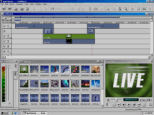
Using dpsNetStream technology, dpsVelocity 7.6 allows digital video professionals to enter a whole new realm of high quality content distribution via the Internet. Popular streaming formats can be created in one step, directly from the timeline. dpsVelocity also includes live streaming capabilities, allowing timelines to be played live to the Internet. Timelines can include a combination of live and pre-recorded video and audio, with titles and transitions providing exceptional webcasting flexibility.
Creation of high quality streaming video files for the web is handled easily from the timeline. Simply choose the file format you want to output, specify the desired size and compression settings, and let dpsVelocity do the work for you. Ligos GoMotion-powered MPEG-1,MPEG-2, RealNetworks RealVideoT , Microsoft Windows Media T , AVI and QuickTime T formats are all supported.
In addition to creating files in streaming formats, dpsVelocity can stream to the web live from the timeline with the included RealNetworks RealVideo and Microsoft Windows Media Format support. Live video from a camera or deck can be combined in real-time with titles, transitions, and previously captured clips, and streamed live to the Internet. And integrated remote control support for an optional Panasonic WJ-MX20T switcher makes multi-camera live webcasting easy.
dpsVelocity-3D-Deluxe Key Features
 Rack-mountable professional video/audio Breakout Box
Fully integrated DPS hardware/software solution
dpsVelocity real time NLE software
Uncompressed and compressed recording modes
Real time support of web video streaming formats
Export MPEG-1, MPEG-2, RealNetworks® RealVideo®, Microsoft® WMV, AVI and QuicktimeT formats
Live webcasting, combining live video and audio with pre-recorded footage, titles and transitions
Integrated remote control support for optional Panasonic WJ-MX20 switcher for multi-camera live webcasting
Enhanced project management architecture
Mix clips captured at different compression levels on timeline
Trim Window supports 3 and 4 point edits
Dual frame buffers for two graphics over real time transitions
Real time rolls and crawls
Full Frame 720x486 (NTSC) / 720x576 (PAL) resolution
Multiple galleries (bins) with search capabilities
Real time picture-in-picture, 3D perspective & rotation
Real time dynamic speed changes
Real time reverse varispeed playback
Real time chroma keyer
200+ customizable real time 2D transitions (12-bit ultrasmooth anti-aliased wipes with colored, softedge borders)
200+ customizable real time 3D transitions (with sub-pixel movement for superb quality)
Real time parametric audio EQ
Balanced & unbalanced stereo audio I/O
Separate stereo audio input for CD or auxiliary source
Real time 8-channel (4 stereo pair) hardware audio mixing
Live video processing including real time titling and transitions
Hardware accelerated rendering for multi-pass effects
Time saving Render BankT technology remembers previously rendered segments
Fully keyframeable proc amp controls
EDL import and export
RS422 control of integrated Batch Capture, Recapture & Print to Tape
Supports optional JOG-4000 external hardware jog/shuttle controller
Integrated waveform/vectorscope display
Flexible video I/O: composite, component & Y/C
Supports optional SDI and DV I/O cards
Dedicated preview channel video output
Adjustable genlock timing referenced to video input
Cayman Graphics Power CGT for professional titling
Sound Forge XPT for audio sweetening
Sonic DVDit! SET for DVD Authoring
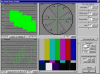 DPS QUALITY CONTROL CENTER
Sophisticated dpsVelocity diagnostic tools, like our integrated waveform monitor and vectorscope display help keep your video levels within spec.
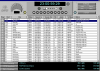 CAPTURING FOOTAGE
The process of digitizing video is accomplished using either quick capture or RS-422 integrated batch capture, complete with VITC/LTC timecode. Both allow for proc amp controls during capture, as well as an on-board waveform and vectorscope display. Whether you're working online or offline, fully functional EDL import and export can be utilized using multiple industry formats.
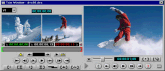 ORGANIZING & TRIMMING CLIPS
Captured clips are easily organized into one or more customizable galleries, which allow playing, sorting, annotating and managing the media on your drives. Trimming individual clips in three or four point fashion is enhanced by the dpsVelocity dual trim window. Slip, slide, insert, overlay, and fit-to-fill modes supplement the ability to trim individual clips directly on the timeline.
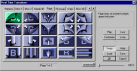 POWERFUL EFFECTS & TRANSITIONS
dpsVelocity transitions and effects are fully keyframable, giving you maximum control. Numerous real time effects are at your disposal, including perspective, speed change, reverse varispeed playback, color correction, cropping, keying, warping, transparency, and more. dpsVelocity even lets you combine video effects with transitions and rolling and crawling titles in complex groupings of up to five layers. Hundreds of pre-designed 2D and 3D transitions are ready to go. You can even key graphics over live video at the touch of a button. For multi-pass effects, dpsVelocity uses fast hardware assisted rendering. To eliminate rerendering, DPS Render Bank technology remembers previously rendered segments, paving the way for flexible experimentation.
DPS VIRTUAL TAPE FILE SYSTEMT
dpsVelocity users can seamlessly share files with other graphics, animation and editing systems via the revolutionary DPS Virtual Tape File System. VTFS makes each frame of video simultaneously available in nine different file formats: SGI, TGA, BMP, PIC, TIF, IFF, VPB, RAS and RLA. Animation sequences can also be rendered directly to dpsVelocity and then easily accessed for editing.
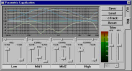 AUDIO EXCELLENCE
As any professional knows, video is only half of the story. Audio features have been enhanced in dpsVelocity to provide real time multi-channel monitoring and hardware mixing of eight audio channels with guaranteed audio sync. Real time EQ has been added for audio sweetening, as well as complete right and left channel panning controls for each audio track. Need more channels? With dpsVelocity, you can even automatically mix down additional audio tracks for real time preview.